Quick Answer: The Ashes is the Test cricket series played between England and Australia, and the most storied rivalry in the sport. It began after Australia's famous 1882 victory at The Oval, when a mock obituary in the Sporting Times declared that English cricket had died and "the body will be cremated and the ashes taken to Australia." England won the next series, and the "Ashes" became the series name. The physical urn — containing the actual ashes of a burnt bail — has been held at the MCC Museum at Lord's since 1927.
The Night English Cricket "Died": The Oval, 1882
To understand the Ashes, you have to understand how shocking Australia's 1882 victory actually was.
On 29 August 1882, at The Oval in London, Australia beat England by 7 runs in a single Test match that left English cricket in collective disbelief. England needed just 85 runs to win. They collapsed to 77 all out. The decisive bowler was Frederick Spofforth — known as "The Demon" — who took 7 wickets for 44 runs in the second innings, frequently bowling so fast that witnesses described stumps cartwhheeling out of the ground.
The very next day, the Sporting Times published a short mock obituary, written by journalist Reginald Brooks, that read:
"In Affectionate Remembrance of ENGLISH CRICKET, which died at The Oval on 29th August, 1882. Deeply lamented by a large circle of sorrowing friends and acquaintances. R.I.P. N.B. — The body will be cremated and the Ashes taken to Australia."
Brooks intended it as a humorous lament. He could not have imagined that this single paragraph would define the Australia–England cricket rivalry for the next 140 years and counting.
How the Urn Was Created
The following English winter, a team captained by the Honourable Ivo Bligh toured Australia with the stated objective — at least in the press — of "recovering the Ashes." The tour became the stuff of romantic legend.
After England won two of the first three Tests, a group of Melbourne women — versions of the story differ, but the most widely cited account credits Lady Janet Clarke, Florence Morphy (who later married Bligh), and some combination of others — burnt a bail or a stump, placed the ashes in a small ceramic urn, and presented it to Bligh as a gift. (Source: Wikipedia – The Ashes)
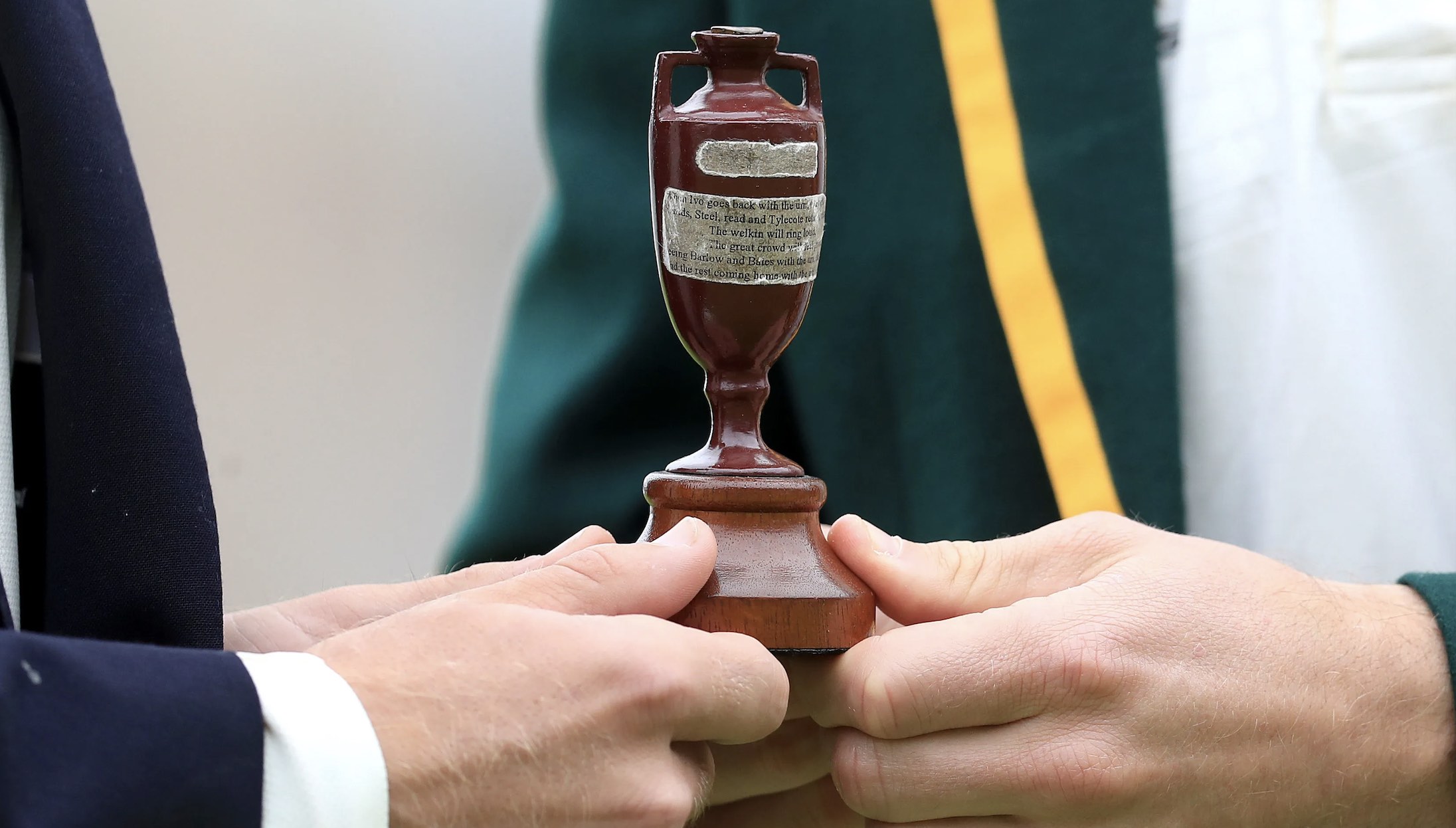
The urn was small — just 10.5 centimetres tall — and was essentially a keepsake, not a trophy. Bligh kept it as a personal memento. When he died in 1927, his widow Florence left it to the MCC, where it has remained ever since in the Lord's Cricket Museum.
Crucially, the urn itself has never officially been the prize of the Ashes series. What the winning team actually receives is the Ashes urn replica — a larger crystal version — along with the Waterford Crystal trophy that has been used since 1998. The original ceramic urn stays at Lord's. (Source: ESPNcricinfo – Ashes history)
The Bodyline Series (1932–33): Cricket's Most Controversial Chapter
Of the many remarkable Ashes series across 140 years, none was more politically explosive than the 1932–33 tour of Australia.
England arrived in Australia led by Douglas Jardine with a specific tactical plan: Bodyline. The strategy, conceived largely by fast bowler Harold Larwood and developed by Jardine, involved bowling fast deliveries consistently aimed at the batsman's body, with a packed leg-side fielding cordon to catch the defensive prod. The target was Donald Bradman, who had averaged 112.29 in the previous Ashes series and whom the English regarded as unplayable by conventional means.
Bodyline worked — Bradman averaged 56.57 in the series, still excellent but a significant reduction — and England won the series 4–1. But the human cost was severe. Australian batsmen Bill Woodfull and Bert Oldfield were hit and injured. The Australian Cricket Board sent a cable to the MCC describing the tactics as "unsportsmanlike." The diplomatic row was serious enough that some historians have suggested it threatened relations between Britain and Australia at a delicate moment in imperial history. (Source: Britannica – Bodyline)
Harold Larwood, the primary bowler, was effectively sacrificed — he was asked to apologise to the Australian public and refused, never playing for England again. He emigrated to Australia in 1950, where he was eventually welcomed warmly. Jardine was not asked to tour Australia again.
Bodyline changed the Laws of Cricket. Restrictions on the number of fielders on the leg side were tightened, and intimidatory bowling became a topic in the Laws. The legacy of 1932–33 still influences how umpires apply the Laws today.
Don Bradman and the Ashes
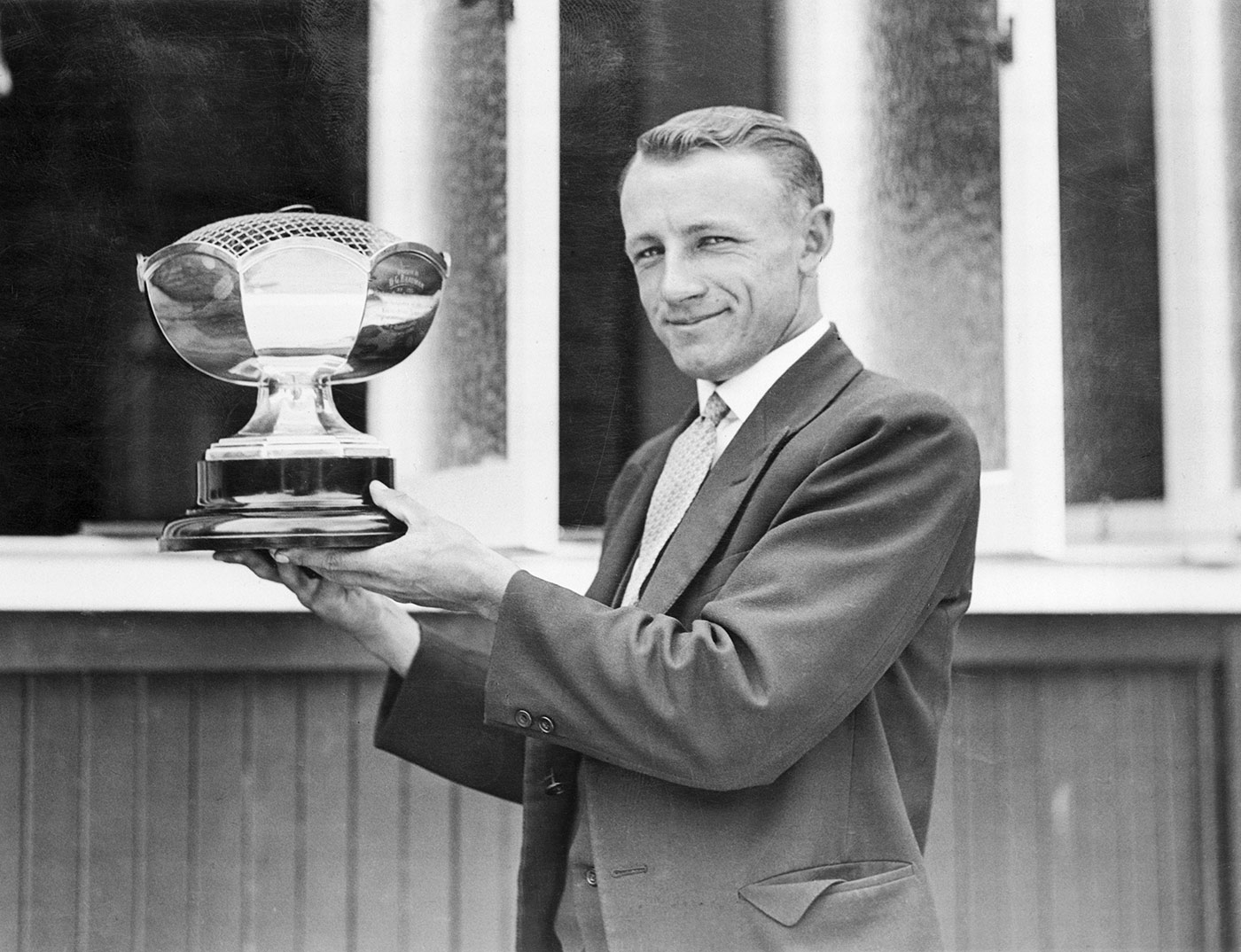
No conversation about the Ashes is complete without Sir Donald Bradman — widely regarded as the greatest batsman who ever lived, and the player whose career gave the Ashes rivalry its most dramatic individual narrative. Bradman's Ashes record was extraordinary: across five series (1930, 1932–33, 1934, 1936–37, 1938), he scored 5,028 runs at an average of 89.78 specifically against England in Test cricket. In the 1930 Ashes series in England alone, he made 974 runs at an average of 139.14 — a record for a single Ashes series that still stands today. (Source: ESPNcricinfo – Don Bradman Test statistics)
The final act of Bradman's Ashes career remains the most poignant moment in the history of the series. Playing his final Test innings at The Oval in 1948, needing just four runs to retire with a Test batting average of 100, he was bowled second ball by Eric Hollies for a duck. His career average stands at 99.94 — the most discussed number in cricket history.
Key Ashes Moments Through History
1882 – The Birth. Australia win by 7 runs at The Oval. The mock obituary is published. The Ashes concept is born.
1894–95 – First Ashes comeback. England win after being 2–0 down — the first time any team had won a five-Test series after being two down.
1932–33 – Bodyline. England's most controversial Ashes victory. Douglas Jardine, Harold Larwood, and a diplomatic crisis.
1948 – Bradman's Invincibles. Australia, led by Bradman in his final series, complete an England tour unbeaten in all matches — the only team ever to do so. They win the series 4–0.
1981 – Botham's Ashes. Ian Botham scores 149 not out at Headingley after England had followed on, then takes 5 for 1 as England win by 18 runs — one of the most extraordinary individual performances in cricket history.
2005 – England's return. After 18 years without an Ashes victory in England, England win 2–1 in a series of almost unbearable intensity, sparking a national celebration.
2013–14 – Australia's 5–0 revenge. Australia win the return series in Australia 5–0, the most comprehensive Ashes victory in modern times.
Who Has Won the Most Ashes Series?
As of 2024, across 73 Ashes series played since 1882:
Australia have won 34 series
England have won 32 series
6 series have been drawn
The overall record is tight, though Australia have been dominant in the modern era. (Source: ESPNcricinfo – Ashes records)
Where Is the Ashes Urn Now?
The original ceramic urn is permanently housed in the MCC Museum at Lord's Cricket Ground in London, where it has been since 1927. It is displayed alongside items including a sparrow killed by Jahangir Khan's delivery in 1936 and the ball used in the 1932–33 Bodyline series.
The urn is considered too fragile to travel — a concern that has caused periodic controversy in Australia, where many feel the original should be held by the winning team. The MCC has consistently declined to release it, maintaining that it is on permanent display for the public as a piece of cricket history.
FAQ: The Ashes
What is the Ashes in cricket? The Ashes is the Test cricket series contested between England and Australia. It takes its name from a mock obituary published in the Sporting Times in 1882, following Australia's famous victory at The Oval, which declared that English cricket had died and its ashes would be taken to Australia. The name stuck, and the series has been known as "the Ashes" ever since.
What is the Ashes urn made of? The Ashes urn is a small (10.5 cm tall) terracotta or ceramic urn, believed to contain the ashes of a burnt cricket bail — possibly one from the 1882–83 series in Australia. It was given to Ivo Bligh, England's captain, by Melbourne women following England's victory. It has been held at the MCC Museum at Lord's since 1927.
How often are the Ashes played? The Ashes is played every two years, alternating between England and Australia. Each series consists of five Test matches. The 2023 series was played in England; the 2025–26 series will be played in Australia.
Who has won the most Ashes series? Australia has won the most Ashes series overall, though England and Australia are relatively close in the all-time count. Australia has been particularly dominant since the 1990s, but England's 2005 victory and their subsequent wins in 2009, 2010–11, and 2015 show the series remains competitive.
What was Bodyline? Bodyline was England's controversial bowling tactic in the 1932–33 Ashes series, in which Harold Larwood bowled fast, short-pitched deliveries aimed at the batsman's body with a packed leg-side field. It was developed specifically to reduce Don Bradman's scoring, and while it helped England win the series, it caused a diplomatic incident between Britain and Australia and led to changes in the Laws of Cricket.
Why does the Ashes urn stay at Lord's? The MCC maintains that the original ceramic urn is too fragile to travel safely and is on permanent public display at the Lord's museum. The winning team receives a replica crystal urn. Australia has periodically argued that the original should tour with the series, but the MCC has not agreed to this.
Sources
Wikipedia – The AshesESPNcricinfo – Ashes history and records
MCC – Lord's Museum: The Ashes Urn
Britannica – Bodyline
ESPNcricinfo – Don Bradman