Quick Answer: Professional cricket grew out of 18th-century England, where wealthy aristocrats began paying skilled village players to represent them in high-stakes gambling matches. By the time the Hambledon Club dominated the 1770s and the Marylebone Cricket Club (MCC) was founded in 1787, paid players were a permanent fixture of the sport. The first fully professional touring team — William Clarke's All-England Eleven — launched in 1846, and Test cricket followed in 1877.
From Sheep Pastures to Cricket Pitches: The Very Beginning
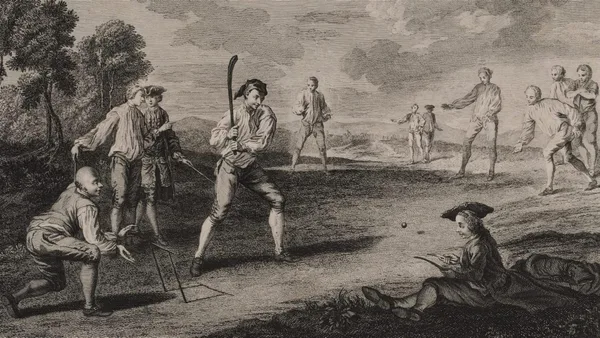
Before there were contracts, match fees, or packed stadiums, cricket was a child's game played in the mud and grass of south-east England.
According to the International Cricket Council (ICC), the sport most likely originated in the Weald — a densely forested region covering parts of Kent, Sussex, and Surrey — sometime during the Saxon or Norman period, well before any written record exists. The earliest confirmed written reference appears in a 1598 court case from Guildford, Surrey, which describes children playing "creckett" on a disputed piece of common land as far back as around 1550. (Source: Wikipedia – History of Cricket)
The game's equipment tells its own origin story. Britannica notes that the wicket almost certainly derived from the gate of a sheep pen — two uprights and a crossbar — which shepherds would defend with a curved staff when other children bowled a ball of wool or rags toward it. The word "bail" comes from the Old French baille, meaning a small door or grille, while "wicket" itself comes from the Anglo-Norman wiket, a small gate. Cricket, in other words, began in a sheep field.
For much of the 16th and early 17th centuries, it remained that way: a rough pastime for children and working men, frowned upon by authorities and the church alike. During Oliver Cromwell's Protectorate in 1654, playing cricket on the Sabbath was prohibited, with fines doubled to two shillings. (Source: Hambledon Parish Council – Cricket History)
Gambling Changes Everything: The Birth of the Professional Cricketer
The transformation of cricket from a village pastime into a professional sport begins with one unlikely force: gambling.
In the years following the Restoration of the monarchy in 1660, the English gentry and aristocracy developed a voracious appetite for betting. Horse racing and prizefighting were already established vehicles for wagers, and cricket — with its unpredictable outcomes and large gatherings — offered a new and exciting arena. The stakes were enormous. According to Wikipedia's History of Cricket, every significant match in the 18th century was played for money, and early newspapers of the period were more interested in publishing the betting odds than match scores.
The key development was what happened because of this gambling culture. As the Wikipedia account of early cricket history explains, wealthy patrons began to realise they could improve their chances of winning bets by recruiting the best players from local villages and paying them to play. In the aftermath of the Restoration, nobles were already employing local experts from village cricket — and these hired players became the earliest known professionals in cricket.
By the early 18th century, significant patrons — including Charles Lennox, the 2nd Duke of Richmond, and Sir William Gage — were assembling what were effectively county-strength teams in Kent and Sussex, staffed by paid village cricketers. (Source: Wikipedia – History of Cricket to 1725)
This was the birth of the professional cricketer: not through formal contracts or governing bodies, but through aristocratic self-interest and the lure of a winning wager.
The First Laws of Cricket (1744): Professionalising the Game Itself
A sport with money on the line needs rules — and in 1744, cricket got its first formal ones.
The Laws of Cricket were codified that year by the "Star and Garter Club," a group of aristocratic patrons whose members would go on to found the Marylebone Cricket Club (MCC) in 1787. According to the ICC's official history of cricket, these laws stated that two umpires — chosen from the gentlemen present — would "absolutely decide all disputes." The MCC quickly became, and remains to this day, the custodian of these laws.
The laws were revised significantly in 1774, when important new provisions were introduced: the lbw (leg before wicket) rule, a third (middle) stump, and a maximum width for the bat — the latter after a player named "Shock" White walked onto the pitch with a bat as wide as the wicket itself. (Source: ICC – History of Cricket)
These codifications didn't just standardise the game; they made it viable for professionals. Clear rules meant disputes could be settled, matches could be organised across counties, and money could change hands without ambiguity.
Hambledon: The Club That Made Professional Cricket Famous
If there is one place that defines the early era of professional cricket, it is a small village in rural Hampshire called Hambledon.
Founded around 1750, the Hambledon Cricket Club — centred around a ground on Broadhalfpenny Down and a pub called the Bat and Ball Inn — became, by the late 1770s, the most powerful cricket club in England. According to the club's own historical records, "No eleven in England could compare with the Hambledon," in the words of John Nyren, son of the club's legendary captain Richard Nyren, writing in his 1833 book Cricketers of My Time.
Hambledon's structure is particularly revealing about how professional cricket actually worked in this era. The club was run by aristocratic patrons — wealthy gentlemen who financed the operation, placed the bets, and occasionally played — but the players themselves were local tradesmen and farmers who were paid to play. As Britain Express notes, the club was sponsored by wealthy patrons, but the cricketers were working men from the village. This division between the paying gentry and the paid professionals would define cricket's social structure for the next two centuries.
Among Hambledon's famous paid players were John Small, Tom Brett, David Harris, Billy Beldham, and Tom Walker — men whose names appear in historical records as the first recognised professional cricketers in the sport. (Source: Wikipedia – Hambledon Club)
The club's influence on the game was lasting. Hambledon essentially standardised the techniques of batting and bowling that persist today. It was at Hambledon that length bowling — pitching the ball rather than rolling it along the ground — was refined and perfected. The club also introduced the three-stump wicket that remains in use, and reportedly kept a wire frame at the ground to measure the width of opposing teams' bats. (Source: Hampshire History)
Hambledon's golden era ran from roughly 1772 to 1793. In 1772, a Hampshire XI — effectively the Hambledon team — beat an England XI by 53 runs at Broadhalfpenny Down, a match recognised by ESPNcricinfo as cricket's inaugural first-class match. By 1777, the club had assembled a side capable of beating the rest of England combined, with thousands of spectators turning out to watch.
Hambledon's dominance ended not through defeat but through geography. When the MCC established Lord's Cricket Ground in London in 1787, the centre of cricketing power shifted irreversibly to the capital. The Hambledon Club held its last recorded meeting in September 1796.
The MCC and Lord's: Cricket Gets a Permanent Home (1787)
The Marylebone Cricket Club (MCC), founded in 1787 from the same circle of Star and Garter Club aristocrats who had written the original Laws, became the sport's governing body almost from the moment of its creation. According to Britannica, the MCC moved to Lord's Cricket Ground — named after its founder, Thomas Lord — first at Dorset Square, then to its current location in St John's Wood in 1814, which became the permanent headquarters of world cricket.
By this point, cricket had a familiar structure: wealthy amateur gentlemen who played for honour and enjoyed the social occasion; and professional players who played for wages and match fees. This distinction was formalised in the famous Gentlemen vs Players fixture at Lord's, which ran from 1806 to 1963 — a 157-year record of cricket's class divide. (Source: Britain Express – Cricket History)
The MCC published its first revised code of laws in 1788 and periodically updated them thereafter. The 1835 revision gave cricket its first truly formal legal framework, which still stands largely intact today.
William Clarke and the All-England Eleven: The First Professional Touring Team (1846)
The single biggest leap toward modern professional cricket came not from a lord or an institution, but from a one-eyed former bricklayer from Nottingham.
William Clarke (1798–1856) was one of the finest bowlers of his generation — an underarm spinner of such control that few batsmen of the 1840s could play him. In 1845, he joined MCC's ground staff at Lord's as a net bowler, where he was well-paid but saw an opportunity that his employers had missed.
In August 1846, when the MCC season ended and the gentlemen departed for the grouse moors, Clarke assembled what he called the All-England Eleven (AEE) — an all-professional touring team of the country's finest cricketers. According to ESPNcricinfo, the team played its first match on 31 August 1846 in Sheffield, wearing white shirts with red polka dots, white trousers, and top hats, against a local side of twenty-two men.
The timing was perfect. The expansion of the railway network across Britain made travel between cities practical for the first time, and Clarke used it aggressively. The AEE toured the length of the country, playing against local sides (often of 18 or 22 players to even the odds) in front of huge crowds in cities that had rarely, if ever, seen top-class cricket. Matches in Sheffield, Manchester, and Leeds were an immediate success. (Source: Wikipedia – William Clarke's All-England Eleven)
Clarke paid his professionals better than MCC did — between £4 and £6 per week — and kept the considerable surplus for himself, which led to eventual revolt. In 1852, John Wisden (who later founded the famous almanac) and Jemmy Dean led a breakaway group of professionals who were dissatisfied with Clarke's ungenerous management, forming the United All-England Eleven (UEE) as a rival touring team. (Source: Wikipedia – William Clarke's All-England Eleven)
Despite the internal politics, the travelling elevens had achieved something historic: they had created a functioning professional cricket circuit. By 1851, the AEE alone was playing 34 matches per summer. In 1859, twelve players from the AEE and UEE combined to form the first-ever England overseas touring team, which travelled to the United States and Canada. (Source: Citizendium – William Clarke)
The legacy of Clarke's model — professional players, paid per match, travelling to meet local opposition — is the direct ancestor of the professional cricket economy that exists today.
The County Championship and the First Test Match (1877–1890)
The travelling elevens eventually gave way to something more structured. As the 19th century matured, county cricket grew in popularity and competitive edge. Sussex had been formally constituted as a county club in 1839, and others followed. The official County Championship — the domestic first-class competition that still exists today — was founded in December 1889 by eight leading county clubs and began play in 1890. (Source: Wikipedia – Cricket)
But the most decisive moment in the professionalisation of cricket had come thirteen years earlier, on the other side of the world.
On 15 March 1877, at the Melbourne Cricket Ground, an England touring team captained by James Lillywhite — himself a professional — took the field against a combined Australian XI. The match was played on equal terms: eleven a side. Australia won. The match was not recognised as a "Test match" at the time, but history has since acknowledged it as the first-ever Test match in cricket. (Source: Britannica)
With Test cricket came the final building block of professional cricket as a global institution: international competition. The sport now had village origins, formal laws, county structures, professional touring teams, and international fixtures. Everything that followed — the Imperial Cricket Conference (later the ICC) in 1909, the first Cricket World Cup in 1975, the Indian Premier League in 2008 — grew from this foundation.
The Gentleman-Player Divide: Amateurism Abolished in 1962
For almost two centuries, English cricket maintained a formal distinction between amateur Gentlemen (who were not paid, or at least claimed not to be) and professional Players (who were openly paid). The two groups even used different dressing rooms at Lord's and entered the field through different gates.
This division was not merely symbolic. According to Wikipedia, many nominally amateur players claimed more than actual expenses — a practice so common that the derisive term shamateur was coined to describe it. The great W.G. Grace, the most celebrated cricketer of the 19th century, was among those who were officially amateur but financially benefited far beyond any reasonable expense claim.
The distinction was formally abolished in 1962, when the MCC announced that all first-class cricketers in England would henceforth simply be called "cricketers." It was the end of a 200-year-old social structure that had shaped everything about how the professional game was organised, paid, and perceived.
Key Milestones: The Making of Professional Cricket
| Year | Event |
|---|---|
| c. 1550 | Earliest evidence of cricket being played in south-east England |
| 1660 | First professional players hired by noble patrons after the Restoration |
| 1709 | First known match using county names |
| 1744 | First Laws of Cricket codified |
| ~1750 | Hambledon Cricket Club founded |
| 1772 | First recognised first-class match (Hampshire vs England at Broadhalfpenny Down) |
| 1787 | MCC founded; Lord's Cricket Ground established |
| 1806 | First Gentlemen vs Players match at Lord's |
| 1839 | Sussex CCC founded — first county club |
| 1846 | William Clarke founds All-England Eleven — first professional touring team |
| 1852 | United All-England Eleven founded (John Wisden) |
| 1859 | First England overseas tour (to the United States and Canada) |
| 1877 | First Test match — Australia vs England, Melbourne |
| 1890 | Official County Championship established |
| 1909 | Imperial Cricket Conference founded |
| 1962 | Distinction between amateurs and professionals abolished in England |
| 1975 | First Cricket World Cup |
FAQ: The Beginning of Professional Cricket
When did cricket become a professional sport? Cricket didn't become professional in a single moment. The first paid players appeared in the mid-to-late 17th century, when aristocratic gamblers began hiring skilled village cricketers to improve their chances in betting matches. By the early 18th century, professional players were a recognised part of the game. The first fully professional touring team — William Clarke's All-England Eleven — was established in 1846.
Who were the first professional cricketers? The earliest known professionals were local village players in Kent, Sussex, and Hampshire, hired by wealthy patrons in the period following the Restoration of the monarchy in 1660. The most celebrated early professionals were associated with the Hambledon Club (c.1750–1796), including John Small, David Harris, Billy Beldham, and Tom Walker.
What is the Hambledon Club and why is it important? Founded around 1750 in rural Hampshire, the Hambledon Cricket Club was the most powerful cricket club in England between roughly 1770 and 1790. It is often called the "Cradle of Cricket" because it standardised batting and bowling techniques, introduced the three-stump wicket, and produced cricket's first great professional players. The oldest recorded first-class match took place at its home ground, Broadhalfpenny Down, in 1772.
When was the first Test match played? The first Test match was played on 15 March 1877, at the Melbourne Cricket Ground, between Australia and England. Australia won. It was played as part of an England overseas tour, with both sides fielding eleven players — a rarity at the time, as England touring teams typically played against local sides of more than eleven.
What was the Gentlemen vs Players match? The Gentlemen vs Players fixture was an annual match at Lord's between amateur "Gentlemen" (often privately wealthy university-educated players) and professional "Players" (who played cricket for their living). It ran from 1806 to 1962, when the formal distinction between amateurs and professionals was abolished in English cricket.
When did the MCC take charge of cricket? The Marylebone Cricket Club (MCC) was founded in 1787 and immediately became the sport's governing body and the custodian of the Laws of Cricket, a role it maintained for nearly two centuries. The International Cricket Council (ICC) was established in 1909 and gradually took over global governance of the sport, but the MCC retains custodianship of the Laws to this day.
Did women play professional cricket in the early years? Women's cricket dates back at least to 1745, when the first known women's match was recorded in Surrey, according to the ICC's official cricket history. However, women's professional cricket as a structured pursuit is a much more recent development. The International Women's Cricket Council was formed in 1958, and women's professional contracts at scale only became standard in the 21st century.
Sources and Further Reading
International Cricket Council – History of CricketWikipedia – History of Cricket
Wikipedia – History of Cricket to 1725
Britannica – Cricket
ESPNcricinfo – William Clarke's All-England Eleven
Wikipedia – William Clarke's All-England Eleven
Wikipedia – Hambledon Club
Hambledon Parish Council – Cricket History
Britain Express – Cricket in England
The Collector – A History of Cricket