Quick Answer
The five best cricket helmets in 2026: 1) Masuri Vision Series Test (best overall, £200), 2) Shrey Masterclass Air 2.0 (best ventilation, £160), 3) Gray-Nicolls Atomic (best mid-range, £110), 4) Kookaburra Pro 2000 (best value, £85), 5) Gunn & Moore Purist (best for juniors, £65). All five meet the BS 7928:2013 safety standard.
Rankings at a Glance
| Rank | Helmet | Price | Best For | Rating |
|---|---|---|---|---|
| 1 | Masuri Vision Series Test | £200 | Best overall | 9.5/10 |
| 2 | Shrey Masterclass Air 2.0 | £160 | Best ventilation | 9.0/10 |
| 3 | Gray-Nicolls Atomic | £110 | Best mid-range | 8.5/10 |
| 4 | Kookaburra Pro 2000 | £85 | Best value | 8.0/10 |
| 5 | Gunn & Moore Purist | £65 | Best for juniors | 8.0/10 |
Why Your Helmet Choice Matters More Than You Think
A cricket ball travelling at 80mph carries enough force to cause severe head trauma. Yet many club cricketers are still using helmets that are several years old, have sustained impacts that may have compromised structural integrity, or do not meet the current British Standard.
The relevant standard is BS 7928:2013 , which specifies the minimum protection a cricket helmet must provide. The ECB recommends replacing helmets every five years regardless of apparent condition. Any helmet struck by a ball should be professionally inspected or replaced. (Source: ECB – Helmet Safety guidance )
1. Masuri Vision Series Test — Best Overall (£200)
The Masuri Vision Series Test is the helmet of choice for the majority of international cricketers. The Vision Series features Masuri's distinctive faceguard design — a single bottom bar and spaced vertical bars — providing exceptional sightlines without compromising coverage.
WHAT WE LOVE: Dense yet comfortable foam liner, lightweight carbon composite shell, adjustable back strap system that fits virtually any head shape. Ventilation is class-leading.
CONSIDER: At £200, it is a serious investment — but a helmet that protects your head for five seasons works out to £40 per year.
BEST FOR: Club players, academy cricketers, anyone serious about maximum protection.
2. Shrey Masterclass Air 2.0 — Best Ventilation (£160)
Shrey has built a strong reputation for helmets that balance safety with comfort in warm conditions. The Masterclass Air 2.0 features ventilated shell channels across the top — noticeably cooler during long innings in hot weather than most competitors.
WHAT WE LOVE: Titanium faceguard — strong and lightweight. Comfortable straight out of the box. Excellent for long-format batsmen in warm or humid conditions.
BEST FOR: Players in hot climates, long-format batsmen, wicketkeepers in warm conditions.
3. Gray-Nicolls Atomic — Best Mid-Range (£110)
The Gray-Nicolls Atomic features a full ABS shell, moisture-wicking liner, and solid steel faceguard. Not as feature-rich as the premium options, but fundamental protection is excellent.
WHAT WE LOVE: Great value at £110. Fits a wide range of head shapes. Durable across a full season of use.
BEST FOR: Club players who want solid protection without paying premium prices.
4. Kookaburra Pro 2000 — Best Value (£85)
At £85, the Kookaburra Pro 2000 offers BS 7928:2013-compliant protection at a genuinely accessible price. Recommended for recreational players, school cricketers, or anyone who plays occasional cricket.
BEST FOR: Recreational club players, school cricketers, net practice use.
5. Gunn & Moore Purist — Best for Juniors (£65)
The Gunn & Moore Purist is designed specifically for younger players with a slightly smaller shell profile and a softer liner. Fully meets BS 7928:2013 and practically priced for parents who know head sizes will change.
BEST FOR: Junior players aged 8–15, schools cricket, academy junior programmes.
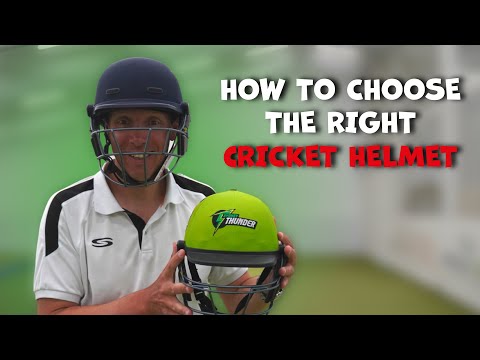
How to Choose the Right Cricket Helmet
Need a new lid but unsure on what to choose and how this should fit? In this video, Richard and Neil talk you through all the things to consider when looking to choose a new helmet!
Helmet Safety: Key Things to Check Before Buying
- BS 7928:2013 compliance — must be clearly marked on the helmet
- Faceguard gap: no gap wider than 35mm between any two bars
- Fit: helmet should sit level, front edge no more than 2cm above the eyebrows
- Replace every five years, or immediately after any significant impact
Frequently Asked Questions
What safety standard should a cricket helmet meet?
All helmets should meet BS 7928:2013 — the British Standard for cricket helmets. Always check the label inside the helmet before purchasing.
How often should I replace my cricket helmet?
The ECB recommends replacing cricket helmets every five years. Any helmet struck by a ball in play should be professionally assessed or replaced — internal structural damage may not be visible.
What is the best cricket helmet for beginners?
For adult beginners, the Kookaburra Pro 2000 (£85) offers full safety compliance at an accessible price. For junior beginners, the Gunn & Moore Purist (£65) is specifically designed for younger players.
Is a more expensive cricket helmet safer?
Not necessarily safer in absolute terms — all helmets must meet BS 7928:2013. More expensive helmets offer better ventilation, lighter materials, superior fit systems, and greater comfort — but the safety floor is the same across all compliant products.