Every year the same thing happens. You walk into a cricket shop or scroll through an online store, and you're staring at 200 bats that all claim to be the best. They all have Grade 1 English willow. They all have "massive sweet spots." They all promise to transform your game. And they range from $80 to $800 with no clear explanation of why.
I've been through this cycle enough times to know that most bat buying guides are just thinly disguised sales pitches. So here's the version I wish someone had given me before I dropped serious money on my first premium bat — and ended up cracking it in three weeks because I didn't knock it in properly.
This is everything you actually need to know.
________________________________________
The Willow Question: English vs Kashmir
Let's start with the biggest decision, because it determines your price bracket immediately.
English willow (Salix alba caerulea) is the gold standard. It's lighter, more responsive, and gives you that satisfying "ping" when you middle the ball. The fibres are softer and more elastic, which means better energy transfer from ball to bat. This is what every professional cricketer in the world uses. It's also significantly more expensive because the trees take 15 years to mature and they only grow in specific conditions — mostly in England's Essex and Suffolk regions.
Kashmir willow is heavier, denser, and considerably cheaper. It's more durable but less responsive. You won't get the same feel or the same power output, but for recreational cricket, tennis ball cricket, or if you're a junior player still developing technique, Kashmir willow does the job without breaking the bank.
Here's what nobody in the marketing copy will tell you: a well-made Grade 2 or 3 English willow bat will outperform a cheap Grade 1 bat every single time. The grade system (1 being the best, 4 or 5 being the lowest) primarily reflects the cosmetic appearance of the willow — how straight the grains are, how few blemishes there are. A Grade 2 bat with slightly irregular grains but excellent pressing and construction will play beautifully. A Grade 1 bat that's been poorly pressed or has the wrong moisture content will disappoint.
So don't get hypnotised by the grade number. Feel the bat. Pick it up. That matters more than any spec sheet.
YouTube
Click to load YouTube content
The TRUTH About Cricket Bat Grades – From the Experts at GM
This video from
AJ Sports does a proper job of explaining the differences between willow grades in plain English — worth watching before you commit to any purchase.
________________________________________
The Grain Myth
While we're debunking things: the number of grains on your bat face is not the quality indicator that most people think it is.
Yes, more grains generally indicate a more mature piece of willow. A bat with 10-12 straight, narrow grains looks stunning and suggests the wood has had years to develop. But grain count alone doesn't determine performance. A bat with 6-8 grains can be just as good — sometimes better — because wider-grained willow tends to be more immediately responsive, while narrow-grained willow sometimes needs more knocking in before it reaches peak performance.
The real things to look at when inspecting a bat face: Are the grains reasonably straight? Is the wood free from major discolouration or deep knots? Does the face feel firm and consistent when you press your thumb across different points?
A bat with six clean, straight grains and good pressing will serve you far better than a 12-grain bat that looks like a museum piece but hasn't been properly prepared.
________________________________________
Weight: The Single Most Important Decision
Forget brand names for a second. The number one factor that determines whether you'll actually play well with a bat is how heavy it feels in your hands.
Cricket bats typically range from about 2lb 6oz (very light) to 2lb 14oz (very heavy). Here's how to think about it:
Light bats (2lb 6oz — 2lb 8oz) are ideal if you're a top-order batsman who relies on timing and placement. They allow faster bat speed, quicker hands through the line, and they're easier to manoeuvre for cut shots, pulls, and flicks. If you play a lot of spin bowling or you like to use your wrists, go lighter. The downside: you sacrifice raw power through the covers and you may find the ball dying off the bat against quicker bowling.
Medium bats (2lb 9oz — 2lb 11oz) are where most club cricketers end up, and for good reason. It's the sweet spot (no pun intended) between control and power. If you play all formats and don't have a dramatically specific batting style, this range is your safe bet.
Heavy bats (2lb 12oz — 2lb 14oz) are for strong players who generate power through their arms and shoulders. These bats hit the ball a long way when you connect. But they're punishing on mistimed shots, they tire your forearms over a long innings, and they're harder to adjust with in time against pace. Unless you're physically strong and batting primarily in shorter formats, think twice.
But here's the crucial part: the number on the scale doesn't tell the whole story. Two bats that both weigh 2lb 9oz can feel completely different because of where the weight sits.
A bat with weight concentrated lower in the blade (low middle, bottom-heavy) will feel heavier in pickup even though it weighs the same as a bat with weight distributed evenly or concentrated higher up (high middle). The pickup — how the bat feels when you lift it with one hand by the handle — matters more than the actual scale weight.
This is why you should always, always, always pick up a bat before buying if possible. Online shopping has its convenience, but nothing replaces the one-handed lift test: hold the bat with one hand at the splice and raise it. It should feel manageable and balanced, not like you're lifting a sledgehammer.
[embed:youtube:https://www.youtube.com/watch?v=cV-x8VBkmsY]
This walkthrough from Cricket Store Online covers how to evaluate pickup and balance in practice — solid fundamentals for any buyer.
________________________________________
Sweet Spot and Profile: Match It to How You Play
The "sweet spot" is the area on the bat face where contact produces the maximum power and the best feel. Where that sweet spot sits depends on the bat's profile — specifically, where the manufacturer has placed the thickest part of the blade (the "swell" or "middle").
Low middle bats have the sweet spot positioned closer to the toe. These are built for front-foot players — batsmen who like to drive through the covers, lean into half-volleys, and play on the front foot against pace. Think of how Joe Root bats. If you're a technically correct player who meets the ball early, a low middle bat is your friend.
Mid-to-low middle bats are the most versatile. The sweet spot is positioned roughly in the centre-to-lower section of the blade. This gives you a good hitting zone for both front-foot and back-foot shots. Most modern bats fall into this category because most players need a bat that does everything reasonably well.
High middle bats push the sweet spot upwards. These are designed for back-foot players — those who like to cut, pull, and play horizontal bat shots. They're also useful on bouncy pitches where you're often dealing with balls at chest height. Less common in club cricket, but popular in Australia and South Africa where pitches tend to have more bounce.
Edge thickness has increased dramatically in recent years. Modern bats can have edges up to 40mm (the MCC legal maximum). Thicker edges mean a larger hitting zone and more forgiveness on off-centre hits. If you tend to edge balls or find yourself connecting with the outer part of the bat frequently, a bat with thick edges will help — the ball still travels rather than dying off the edge.
The trade-off is that thicker edges mean more weight in the blade. So a full-profile bat with massive edges will feel heavier than a bat with a more traditional, slimmer profile even if they weigh the same on paper.
________________________________________
The Brands Worth Knowing in 2026
I'm not going to rank these because choosing a brand is personal. But here are the major players and what they're known for, based on years of watching what actually performs:
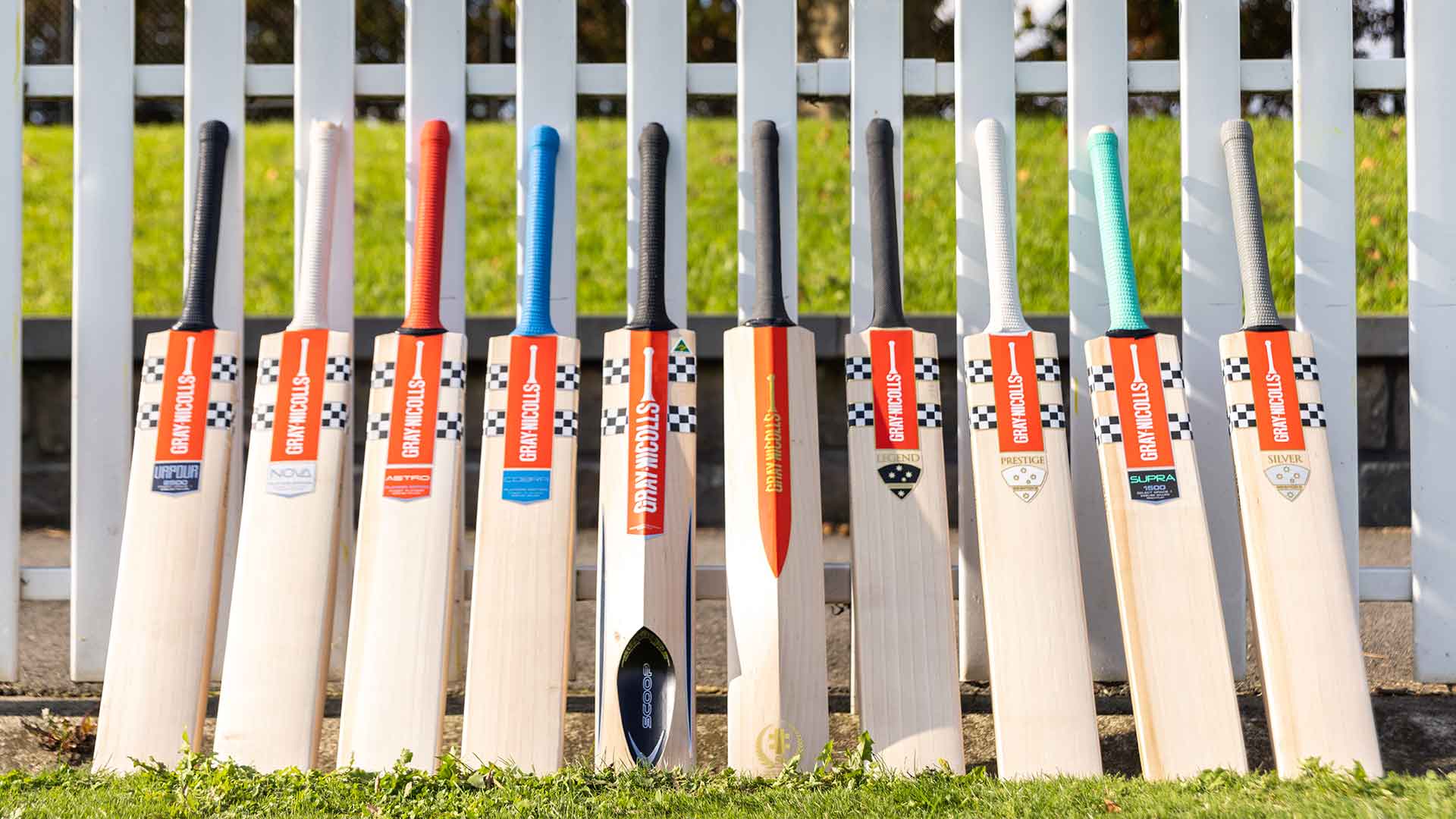
Gray-Nicolls
One of the oldest bat makers in the world, going back to 1855. They've supplied bats to legends from Sir Vivian Richards to Joe Root to Harry Brook. Their strength is classical craftsmanship — Gray-Nicolls bats tend to have exceptional balance and feel. If you're a timing-based player who values how the bat sits in your hands over raw power, look here first.
Their Neocore range for 2025-26 has been getting serious attention. Wisden Cricket Monthly tested it and their editor called it the best Gray-Nicolls he'd ever picked up — chunky profile but unbelievably light on the pickup thanks to a patented cored internal scoop.
The Powerspot is their other flagship, endorsed by Joe Root. Strong spine, good bow, designed for players who want to drive and time the ball.
Kookaburra
The Australian giant. Kookaburra bats tend to be power-oriented — big edges, pronounced bow, and a focus on generating maximum ball speed. They're the brand of choice if you want to hit the ball hard and far.
Their Kahuna line has been around for years and remains one of the most popular mid-range to premium bat choices globally. The Ghost range, associated with Marnus Labuschagne, is built for all-format play with a traditional profile and emphasis on balance.
For 2025-26, the Nickel range has been well-received. The Cricketer magazine tested it and testers used words like "loved" — one even said the ping off the extended sweet spot was notable enough that it could ride out mishits.
[embed:youtube:https://www.youtube.com/watch?v=FhGDUBYFC_o]
Worth watching Kookaburra's own breakdown of their 2025-26 bat range — you can see the profile differences between the Kahuna, Ghost, and Stealth lines clearly.
Gunn & Moore (GM)
The oldest bat manufacturer still in production, founded in 1885. GM bats are engineered with a slightly more scientific approach — their DXM fibre handle technology reduces vibration and shock on impact, which is noticeable immediately when you pick one up.
Their Diamond range (Ben Stokes' bat) is a mid-profile, full-face bat built for aggressive stroke play. Thick spine, good edges, designed for people who hit the ball hard. If you're a front-foot dominant player who likes to get through the line, the Diamond is a strong option.
The Noir series is their innovation play — sleek design, lighter weight, targeted at younger players who want modern aesthetics with solid performance.
SG (Sareen Sports)
India's most respected bat brand. Virat Kohli has been associated with SG for years, and their bats are built to handle the specific demands of subcontinental conditions — hard, abrasive pitches that punish bats and reward durability.
SG bats tend to run slightly heavier than their English and Australian counterparts, but the build quality for the price is excellent. The Sunny Tonny with Grade 2 English willow is often cited as one of the best value bats on the market — performing at roughly 90% of a premium bat at half the price.
If you play primarily on matting wickets, concrete strips, or in conditions where the ball scuffs the bat face aggressively, SG's toughness is worth considering.
SS (Sareen Sports Industries)
Another major Indian brand, SS has gone global rapidly. The Ton range is their flagship, with player editions linked to Surya Kumar Yadav and other Indian internationals. Known for large sweet spots and aggressive profiles suited to T20-style batting.
Their Kashmir willow options at the entry level (SS Custom, SS Cambridge) are probably the best budget bats available for beginners who want something that actually functions properly without spending over $80.
New Balance
Relatively new to cricket compared to the traditional bat makers, but they've made serious inroads thanks to relationships with Joe Root (previously) and Steve Smith. Their TC range is the premium line, and the DC (David Warner's old line, now Steve Smith's) is known for massive edges and aggressive profiles.
Wisden's testers described the New Balance entry for 2025 as "solid, sturdy, trusty, and consistent" — not the most exciting adjectives, but exactly what you want from a bat you're trusting with your weekend average.
________________________________________
How Much Should You Actually Spend?
Let me be direct about this, because the price ranges are wide enough to cause real confusion:
$50-100 (Recreational/Tennis ball): Kashmir willow bats from SG, SS, or Cosco. Fine for park cricket, tennis ball cricket, and juniors. Don't expect them to perform in a league match with a leather ball.
$100-200 (Club cricket entry): This is where you start getting Grade 3 English willow or premium Kashmir willow. Bats like the SG Sunny Tonny, SS Player Special, or entry-level Kookaburra/Gray-Nicolls models. For most club cricketers playing on weekends, a well-chosen bat in this range will genuinely perform.
$200-400 (Serious club cricket): Grade 1-2 English willow. This is the sweet spot for most players who take cricket seriously but aren't playing professionally. You get proper craftsmanship, good balance, responsive willow, and a bat that will reward your technique. The Gray-Nicolls Powerspot, Kookaburra Kahuna mid-range, GM Diamond mid-range — all fall here.
$400-800 (Premium/Professional): Grade 1+ English willow, hand-selected clefts, player edition specifications. Unless you're playing at a high level (first-grade club, representative cricket, or professional), you genuinely do not need to spend this much. A $250 bat and a $600 bat of the same brand often use similar willow — you're paying for hand-selection, cosmetic perfection, and the player name on the sticker.
The honest advice: most club cricketers will be perfectly served in the $150-300 range. Spend the money you save on a proper knocking-in mallet and linseed oil instead.
[embed:youtube:https://www.youtube.com/watch?v=mSqONQ8j17Y]
This budget bat comparison test is worth your time — shows you don't need to spend a fortune to get a bat that actually performs at club level.
________________________________________
The Part Nobody Wants to Talk About: Bat Preparation
You've bought the bat. You're excited. You want to take it to nets immediately.
Don't.
A brand new cricket bat — even an expensive one — is not match-ready out of the box. The willow fibres haven't been fully compressed. If you take a new bat straight into the nets and start facing leather balls at pace, you'll damage it. Edge cracks, toe splits, seam marks that go too deep. I've seen people ruin $400 bats in their first session because they skipped this step.
Oiling
Apply a thin coat of raw linseed oil to the face, edges, and toe of the bat. Use your finger or a soft cloth. Two to three teaspoons total — you want a light sheen, not a puddle. Never oil the splice (where the handle meets the blade), the handle, or over the stickers.
Let it absorb horizontally, face-up, for 24 hours. Then repeat once more. Two light coats is plenty. Over-oiling is a common mistake — it clogs the wood fibres, deadens the bat, and makes it sluggish. More oil does not mean more protection. It means a worse bat.
Knocking In
This is the crucial step. Using a bat mallet (they cost about $10-15 and they're worth every cent), gently tap the face of the bat starting at medium pressure. Work your way across the entire face, then the edges using glancing blows off the face — never hit the edges or toe directly head-on.
Gradually increase the intensity over multiple sessions. You're aiming for about 4-6 hours of total knocking-in time spread across several days. The edges and toe need the most attention because they're the most vulnerable.
After the initial knocking in, take the bat to nets and face some gentle throwdowns with an old ball. Check for seam marks. If you're getting deep indentations, the bat needs more work. If the marks are shallow and the bat feels solid, you're getting close.
[embed:youtube:https://www.youtube.com/watch?v=NKhE4fEHSqg]
This step-by-step knocking in tutorial from B3 Cricket is one of the best I've found — they're actual bat makers in Nottingham and they show the exact technique and pressure levels.
Protective Gear
Once knocked in, apply an anti-scuff sheet to the face and fibre tape to the edges. This adds a layer of protection that significantly extends the bat's life. Good anti-scuff sheets cost $5-10. That's the cheapest insurance policy in cricket.
A toe guard is also recommended, especially if you play on hard pitches. The toe takes a beating from yorkers, from tapping the crease, and from general ground contact. A cracked toe is one of the most common bat injuries and it's almost entirely preventable.
________________________________________
Ongoing Bat Care
Your bat is a piece of natural wood. It responds to temperature, humidity, and how you treat it. Here's the maintenance routine that keeps a bat performing for 2-4 seasons:
After every match or net session: Wipe the bat down with a dry cloth. Check for any new cracks, especially around the edges and toe. If you see surface cracks, don't panic — minor surface cracking is normal and doesn't affect performance. Deep structural cracks are a different story and may need professional repair.
Every 4-6 weeks during the season: Lightly sand the face with fine sandpaper to remove surface scuffs, then apply one thin coat of linseed oil. Let it absorb for 24 hours before using again.
Storage: Always store your bat horizontally in a cool, dry place. Never leave it in a car boot, a damp changing room, or in direct sunlight. Temperature extremes and moisture are the enemies of willow. A bat cover (about $15) is worth it for transit and storage.
Off-season: Give the bat a light oil, wrap it in a cover, and store it horizontally somewhere with stable temperature. Check it once a month during winter. Before the new season starts, give it another light oil and a brief knocking-in session to wake the fibres back up.
[embed:youtube:https://www.youtube.com/watch?v=0D5Kpxsceq8]
This seasonal bat care routine from Talent Cricket covers the end-of-season and pre-season process in solid detail — essential viewing if you want your bat to last.
________________________________________
The Quick Decision Framework
If you're still feeling overwhelmed, here's how I'd narrow it down:
Step 1: Set your budget honestly. Don't stretch for a bat you can't afford — a well-chosen $200 bat will serve you better than a badly-chosen $500 bat.
Step 2: Decide on willow type. Playing leather ball in a league? English willow. Tennis ball cricket or complete beginner? Kashmir willow is fine.
Step 3: Determine your ideal weight range based on your build and playing style. If in doubt, start in the medium range (2lb 9oz — 2lb 11oz).
Step 4: If you can, pick up the bat in person. Do the one-handed lift test. Shadow bat with it. If it feels right, it probably is.
Step 5: Check the return policy. Reputable retailers allow returns within 7-14 days if the bat hasn't been used. Buy from someone who stands behind their product.
Step 6: Once you've bought, invest the time in proper preparation. Oil it, knock it in, protect it. This part is non-negotiable.
________________________________________
Final Word
There is no perfect bat. There's only the right bat for you, at this point in your development, for the cricket you play. A weekend club cricketer doesn't need the same bat that Harry Brook uses for England. A 15-year-old developing their technique doesn't need a 2lb 12oz monster. A tennis ball cricketer doesn't need Grade 1 English willow.
What every cricketer does need is a bat that feels balanced in their hands, suits their style of play, and has been properly prepared before it faces its first ball. Get those three things right and you'll score runs. It really is that simple.
The brands and models I've mentioned here are recommendations, not commandments. If you pick up a bat from a brand I haven't mentioned and it feels like an extension of your arms, buy it. Trust your hands over any review — including this one.
Now go score some runs.
________________________________________
Have a bat you swear by, or one you regret buying? Drop us a message through the contact form — we'd love to hear your experiences for future gear reviews.
________________________________________