Quick Answer: William Gilbert Grace (1848–1915) is widely regarded as the father of modern cricket. In a career spanning from 1865 to 1908, he scored 54,896 first-class runs and took 2,876 wickets — numbers that were almost incomprehensible to his era. More than his statistics, Grace transformed cricket from a sport of gentlemen amateurs into a professional spectacle, invented modern batting technique, and became the first global sporting superstar.
Who Was W.G. Grace?
When people describe a cricketer as having "changed the game," it is usually hyperbole. When they say it about William Gilbert Grace, it is almost literal.
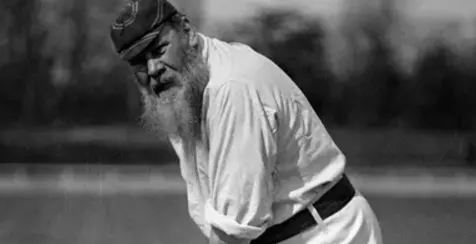
Born on 18 July 1848 in Downend, near Bristol, Grace came from a cricketing family — his father Henry, his uncle Alfred, and his brothers E.M. and G.F. all played at a high level. But from childhood, it was clear that W.G., as he became universally known, was different from any cricketer who had come before him.
By the age of 16, he had made his first-class debut for Gentlemen of the South. At 17, he scored 224 not out. He would continue playing first-class cricket until he was 60 years old.
According to Britannica's profile of Grace, his influence on cricket was so great that the sport is divided into two eras: before Grace and after Grace.
How Grace Changed Batting Forever
Before W.G. Grace, batting was a reactive art. Batsmen played the ball late, kept their bats low, and were largely at the mercy of the bowler. The dominant bowlers of the mid-19th century — fast underarmers and early round-armers — largely dictated terms.
Grace changed this completely. Drawing on his extraordinary eyesight, physical strength (he was 6 feet tall and would eventually weigh over 18 stone), and ruthless intelligence, he invented what we would today recognise as the basic principles of batting:
Moving to the pitch of the ball rather than waiting for it
Playing off the front foot to drive good-length deliveries
Using the full face of the bat consistently
Judging length early and deciding the shot before the ball arrived
These techniques, which modern coaches teach as fundamentals, were radical innovations in the 1860s and 1870s. According to ESPNcricinfo's historical records, Grace made batting a craft of domination rather than survival. He didn't just score runs — he took the game to bowlers in a way nobody had done before.
The numbers bear this out. In 1871, at the age of 22, Grace scored 2,739 first-class runs at an average of 78.25 — at a time when the average first-class batting average hovered around 20. He was playing a completely different game from everyone else on the field.
The Statistics That Defy Belief
W.G. Grace played first-class cricket from 1865 to 1908 — a career of 43 years. His final first-class record, as documented by ESPNcricinfo, stands at:
54,896 first-class runs at an average of 39.55
126 centuries — the first player ever to reach 100 first-class hundreds
2,876 first-class wickets at an average of 17.99
877 catches
These are remarkable numbers in any era, but placed in context they are almost supernatural. When Grace scored his first hundred hundreds in 1895, at the age of 46, it was treated as a national event. The MCC gave him a cheque for £9,073 — donated by readers of the Daily Telegraph — and the Prince of Wales sent a personal telegram of congratulation. (Source: Wikipedia – W.G. Grace)
His Test match record — 22 matches, 1,098 runs, 9 wickets — looks modest by modern standards, but he played in an era when Tests were rare. When he captained England, they won. More importantly, when he played, people came.
The Champion and the Rise of Cricket as Spectacle
W.G. Grace didn't just transform the way cricket was played. He transformed what cricket was for.
By the 1870s, Grace had become the first genuine sporting celebrity in Britain. Crowds of 20,000 and more turned out specifically to watch him bat — not to watch the match, but to watch him. Touring teams from Australia, when they arrived in England, were judged by whether they could dismiss Grace cheaply. When Australia beat England in 1882 — a defeat that gave rise to the fictional Ashes obituary notice in the Sporting Times — Grace was 33, still the most important player on the pitch.
His fame made him rich. Though he played nominally as an amateur "Gentleman," Grace was in practice better compensated than any professional. He accepted large "expenses" payments for tours, demanded and received £10 per match in appearance fees, and in 1895 collected the public subscription described above. As Wikipedia records, he was in every practical sense a professional, despite the nominal amateur designation that protected his social standing. The term "shamateur" — a gentleman who profited from the game while maintaining the fiction of amateurism — was largely invented to describe him.
This commercial reality transformed what cricket matches meant. A Grace appearance guaranteed a gate receipt. Promoters planned fixtures around him. He was, in the modern sense, a franchise player — and cricket became, partly through him, a commercial entertainment industry.
Grace at Test Level: England's First Great Captain
W.G. Grace played 22 Tests for England between 1880 and 1899, captaining the side 13 times. England won eight of those 13 Tests under his captaincy.
His Test debut, in September 1880 at The Oval — England's first-ever home Test match — produced scores of 152 and 9, the 152 being England's first ever Test century on home soil. (Source: ESPNcricinfo – W.G. Grace Test career)
But it was his captaincy style, not just his batting, that left a lasting mark on Test cricket. Grace was a ferocious competitor who understood that Test cricket was a chess match as much as a physical one — he was among the first to use field placements deliberately to restrict scoring and force mistakes, and he was ruthless in his use of declarations and delays when the match situation demanded it.
His famous remark — allegedly made when a bail blew off his wicket without the ball touching it and he simply replaced it and continued batting, saying "The public have paid to watch me bat, not to watch you bowl" — may be apocryphal, but it perfectly captures his understanding of cricket as performance and commerce.
Grace's Legacy: What He Left Behind
W.G. Grace died on 23 October 1915, at the age of 67, after a stroke — reportedly exacerbated by distress at the Zeppelin raids over London during the First World War. He left behind a sport fundamentally different from the one he had inherited.
His specific legacy includes:
The professionalisation of cricket culture. Grace's commercial success demonstrated that cricket could sustain a professional economy. His career prepared the ground for the County Championship, the Ashes rivalry, and eventually Test cricket as an international institution.
Modern batting technique. The front-foot drive, the cut, the pull — all played with a full bat and aggressive intent — were standardised by Grace and passed down through coaches ever since.
The concept of the cricketer as public figure. Grace was arguably the world's first sporting celebrity. His bearded face appeared on cigarette cards, advertisements, and newspaper front pages across the British Empire. He invented what we would now call personal branding.
The Ashes rivalry. It was Grace's era — specifically England's shock home defeat to Australia in 1882 — that gave birth to the Ashes as a cultural phenomenon. Grace played in the first five Ashes series.
Key Facts: W.G. Grace
| Fact | Detail |
|---|---|
| Full name | William Gilbert Grace |
| Born | 18 July 1848, Downend, Gloucestershire |
| Died | 23 October 1915, Mottingham, Kent |
| First-class debut | 1865 (aged 16) |
| First-class career | 1865–1908 (43 years) |
| First-class runs | 54,896 |
| First-class centuries | 126 |
| First-class wickets | 2,876 |
| Test matches | 22 |
| Test runs | 1,098 (avg 32.29) |
| Profession (official) | Doctor (amateur cricketer) |
| Profession (reality) | Professional cricketer |
FAQ: W.G. Grace
Why is W.G. Grace called the father of cricket? Grace is called the father of modern cricket because he single-handedly transformed batting technique, made cricket into a commercial spectacle, and dominated the sport across four decades so completely that the game changed around him. His methods — front-foot play, reading length early, full bat face — became the standard taught to every cricketer who followed.
Was W.G. Grace actually a professional cricketer? Officially, Grace played as an amateur Gentleman, a distinction that carried high social status in Victorian England. In practice, he was paid very well — through large expenses payments, appearance fees, and public donations — making him what journalists of the time called a shamateur. The financial reality of his career directly influenced the eventual abolition of the amateur-professional distinction in 1962.
How many first-class centuries did W.G. Grace score? Grace scored 126 first-class centuries, becoming the first cricketer in history to reach 100 first-class hundreds, a milestone he achieved in 1895 at the age of 46. The achievement was treated as a national event and celebrated across the British Empire.
What was W.G. Grace's batting average? Grace's first-class batting average was 39.55 across 54,896 runs in 1,478 innings. His Test batting average was 32.29. While these averages appear modest by modern standards, they need to be understood in the context of 19th-century pitches, bowling, and equipment — when the average first-class batting average was around 20, Grace's numbers were extraordinary.
When did W.G. Grace play his last match? Grace played his last first-class match in 1908 at the age of 60 — an almost unimaginable career length. He continued to play club and minor cricket after that, finally retiring from all cricket around 1914, just a year before his death.
How did W.G. Grace influence modern cricket? Grace invented the technical foundation of modern batting, commercialised cricket as a spectator sport, created the concept of the cricket celebrity, and through his era established the Ashes rivalry. Almost everything about modern cricket — the way batsmen play, the way grounds make money, the relationship between stars and fans — has roots in what Grace built in the second half of the 19th century.
Sources
Britannica – W.G. GraceWikipedia – W.G. Grace
ESPNcricinfo – W.G. Grace player profile
MCC – History of the Laws